Supporting education, educating for sustainability
Lorenzo Vascotto and Flaminia Raiteri, Pedagogists, “Argentovivo” Cooperative, Correggio (RE)Alessandra Cassinadri, Inhabitants’ cooperative “Andria”, Correggio (RE)
The partnership experience between the “Argentovivo” and “Andria” cooperatives in the provinces of Modena and Reggio Emilia
The concept of sustainability has been evoked more than ever in recent years: from politics to economics, from construction to agriculture, from science to pedagogy, numerous fields are placing at the center of their research and reflections the idea that any action, behavior, thought, project, or choice must be measured against its own durability over time, without coming at the expense of others or anything else. Our contemporary world seems to have reached a critical point: the resources necessary for the survival of our species and our planet, as we know it today, are gradually decreasing and it is becoming necessary to ask ourselves what the world will be like for the generations that will come after us.
From these reflections, the idea of creating highly sustainable early childhood education services, both structurally and pedagogically, emerged. This project was spearheaded by the members and employees of the “Andria” residents’ cooperative, based in Correggio (RE), in the early 2000s. Since 1975, this cooperative has been designing and implementing housing projects (houses, neighborhoods, urban developments, etc.), striving to place residents—the people with their needs, desires, and dreams—at the center of its thinking and interventions through listening, participation, and sharing. Over time, the need emerged to enhance their neighborhoods with cooperative-owned educational services, managed with innovative formulas, including the creation of a social cooperative that could ensure female employment, high professionalism, connections with the local community, research, and innovation. Thus, in May 2002, “Argentovivo” was born, with the aim of designing and managing early childhood education services.
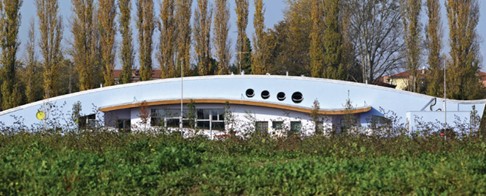
The partnership between the two companies has been strong and solid from the beginning, resulting in the joint construction of numerous facilities designed to become nursery and preschool centers: seven buildings constructed over eight years, which have become four preschools and three preschools. The shared planning of these facilities was born from a strong belief in the value of collaboration: bringing together diverse skills and knowledge always generates innovative opportunities. And in this aspect, we can already find elements of sustainability, which especially concerns ideas and projects: the more they are shared, the greater their chance of being sustainable, because they are the fruit of commitment, dedication, and caring for multiple stakeholders.
Designing facilities that focus on the well-being and growth of children, families, and their communities was a major challenge, one that was approached from the outset with the certainty that sustainability could not be ignored. Together, we wanted to create something important and useful, something that could continue to offer advantages and benefits over time, something that could improve people’s quality of life without harming anyone or anything. For this reason, we have always created multidisciplinary teams (architects, engineers, pedagogists, teachers, parents) capable of discussing the best solutions, ensuring the representation and legitimacy of all perspectives, from the design on paper to the construction of walls, partitions, ceilings, and so on.
The sustainability we sought and pursued involves multiple levels:
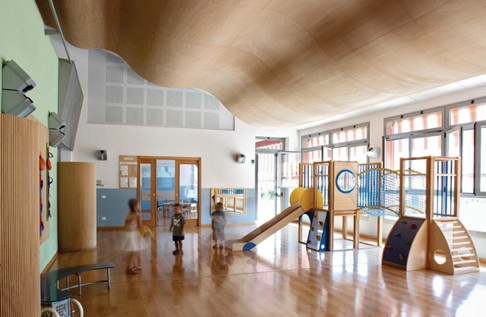
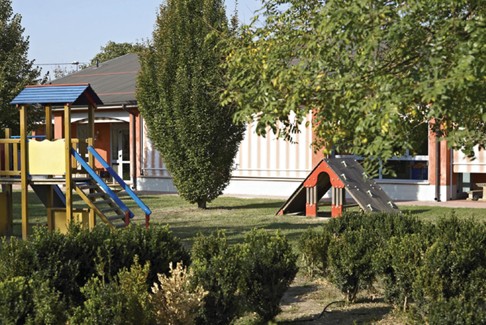
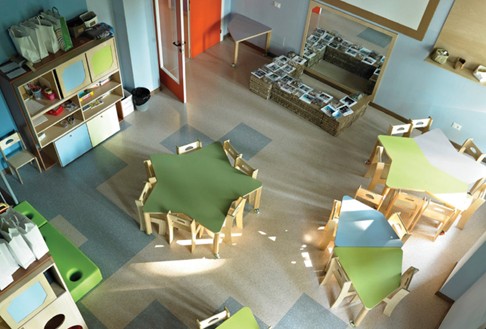
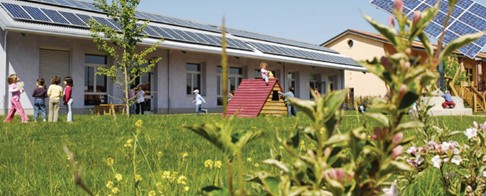
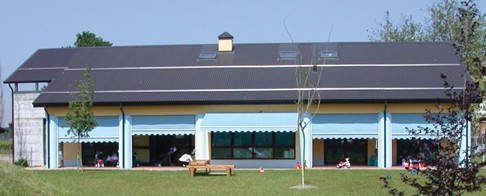
The environmental and structural level:This level is crucial for creating buildings that respect the environment in which they are built. This sustainability approach focuses primarily on reducing energy consumption, including the installation of solar panels on the roofs, insulation systems that eliminate the need for air conditioning, underfloor heating, and sound-absorbing ceiling materials for acoustic comfort. A specific approach was also adopted regarding the presence of large, well-developed green areas, prioritizing the growth of natural elements rather than the placement of outdoor furniture made of plastic or other materials.
The social and territorial level:We chose to build the facilities in suburban municipalities, in small neighborhoods, mostly residential, often connected to the city center by cycle and pedestrian paths, sharing ideas and projects with local neighborhood committees or citizen associations, both during the construction and management phases of the facilities. Today, all active services have the opportunity to serve as community hubs, promoting initiatives, events, cultural and educational opportunities open to all citizens, not just users. Sustainability, in this case, enhances the social relations of a region, fostering participation, aggregation, discussion, and conviviality.
The educational level: From the beginning, we wanted educational services that would value children, their ideas, their research, and their sensitivities. To do this, we approached them directly, forming small project groups and asking them how they would like their schools to be. In three out of four cases (the “Balena Blu” school, the “Tatonius” school, and the “Thea” school), the children’s ideas were implemented concretely. We are convinced that listening to children, their perspectives, and their ability to make sense of reality, is a major step toward pedagogical sustainability: a more sustainable world is created by more aware, critical, and thoughtful citizens, who have been trusted (in themselves and their resources) from a very young age, experiencing the importance of expressing their ideas and being listened to and valued.
These characteristics are part of the profound identity of these places, and they still speak today, communicate, and educate. They speak to the families attending the first year of preschool with their child, but also to the neighborhood residents, administrators, and staff who work in these facilities. And above all, they speak to children, with the hope and trust that much of the well-being, present and future, of our planet passes through their hands, their minds, and their hearts.