

i-Vulcani: STEM-themed craft tables
Introducing young children to STEM: what are the solutions for engaging science in preschool and elementary school? The answer lies in the powerful yet simple combination of concrete, tangible solutions you can touch with your hands and an innovative educational method.
A concrete and immersive solution: i-Vulcani, making tables for STEM learning
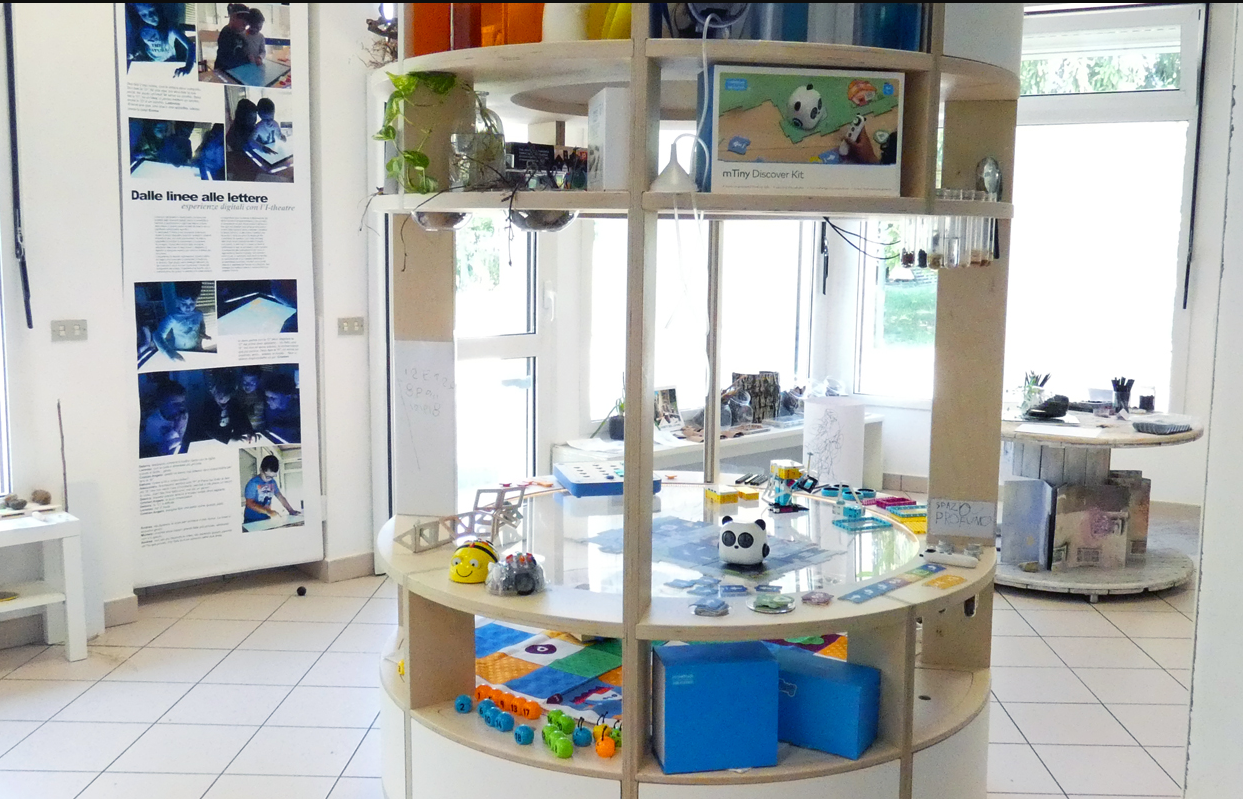
i-Vulcani is a making table with many accessories, making it a true learning environment that promotes STEM learning for young children through scientific exploration, observation, and the study of the infinite states of transformation of matter, as well as the principles of coding and robotics.
i-Vulcani is a world of exploration in three dimensions: developed on three levels Vertical, allows you to study scientific phenomena from different points of view and angles.
It integrates different innovative technologies, enabling an immersive and perceptive learning experience through the use of lights, colors, smells, aromas, sounds, music, and much more. Mounted on wheels, it can be transported to different areas of the school.
Each piece is made entirely of birch wood, with shelves equipped for STEM subjects, containers for storing materials, and innovative technologies that characterize its vocation and enhance the educational experience.
The purchase of i-Vulcani also includes introductory training on its use, while more specific training on its use can be requested and quoted separately.
i-Vulcani can also be integrated with numerous additional STEM supports, and is a truly unique support surface for making and scientific observation.
The Learning by educational method Languages® and the Educational Context
i-Vulcani is more than just a table for making and scientific observation: behind its design is the Learning by Languages® educational method.
National and European guidelines emphasize the importance of introducing boys and girls to STEM subjects (science, technology, engineering, and math) to develop key skills that prepare them for the challenges of the future, taking into account the connections with the arts, creativity, and innovation. For this reason, a new acronym STEAM has been created, introducing the “A” for art, or we would say for “atelier,” in its declination of the hundred languages, in dialogue with scientific disciplines.
The Learning by Languages® educational method, one of the most cutting-edge in the national and international scene, has among its pillars the development of creative and divergent thinking and digital teaching innovation. The research team that developed it has developed these authentic learning environments, i-Vulcani, which introduce boys and girls aged 3 to 8 to learning science in a unique way, accustoming and engaging them in scientific exploration and research, through specifically designed paths and contexts. Boys’ natural propensity for exploration, manipulation, and the formulation of hypotheses, to transform them into scientific concepts, requires an “ecologically rich context.” Spontaneous experience is not enough; contexts are needed that guide and focus children’s attention and research, supported by the teacher’s work. Teachers must support challenging thinking: comparing hypotheses, facilitating metacognition, comparing different theories, and encouraging the creation of hypotheses, in that fertile boundary that, according to the socio-constructivist perspective, is the zone of proximal development. Boys and girls do not suddenly discover themselves as scientists in middle or high school, but they can gradually develop the prerequisites and skills that will allow them to approach scientific disciplines and express themselves in a more articulate scientific language, if they have had significant learning opportunities in early childhood and the very first years of primary school. To this end, it is important that the curriculum for this age group focuses on experiences and tools that can foster children’s approach to scientific thinking, a thinking that will then find opportunities for further study and revitalization within specific school subjects in subsequent years.
The i-Vulcani Concept
i-Vulcani are “totemic micro-architectures on wheels,” tables for STEM making and learning that become true catalysts of attention and curiosity, around which to develop a new ergonomics of knowledge, configured as an embrace to share the pleasure of discovery.
The “volcano metaphor” brings us back to the idea of the emergence of hidden aspects of knowledge, as a point of energy and concentration, as a passage between the “underworld” and the “overworld,” between the micro and the macro, between what has already emerged and what is still fermenting beneath the surface.
The vertical perspective and aesthetic dimension fascinate children, playing a driving role in the processes of knowledge, while the circular shape stimulates an enveloping ergonomics, involving children in the shared journey of exploration and experimentation.
To the classic light table commonly in use, i-Vulcani adds a new complexity in the possibility of investigation, through the visual relationship between the main work surface (which is indeed luminous, transparent or opaque) and the surface below, fueling a wealth of glimpses and viewpoints that find a momentum towards upwards, guided by the enveloping volume of the structure that integrates technologies and devices to generate and manage the interaction with lights, colors, aromas, and sounds in a 360-degree sensorial experience, recreating the sensation of inhabiting a large kaleidoscope.
Some research possibilities with i-Vulcani
Doing science with i-Vulcani means having a learning environment that enhances children’s curiosity, doubt, critical thinking, and the exchange of ideas, accompanying them in the search for new information, thus welcoming their diverse curiosities to always seek new explanations. Scientific observation takes place through innovative digital media with the use of specific research and exploration kits.
Science is “the art of finding,” a continuous process, an experimentation that proceeds through trial and error: with i-Vulcani it is possible to follow this flow of discovery and investigate different scientific fields, from environmental protection to the rediscovery of the natural world, using different levels of observation, thus training different perspectives.
i-Vulcani also allows dialogue between different languages, science, mathematics, coding, etc.
Furthermore, on i-Vulcani it is possible to observe and grow different types of seeds, thus investigating concepts such as transformation, photosensitivity, hydroculture, life cycle, biodiversity, drying, dehydration, or reflect on certain physical phenomena such as steam (how is it formed? What shape does it have? Is it possible to create paths or ‘capture’ it to observe it over time?).
In short, i-Vulcani is a table for making capable of supporting STEM experiences Transversal and collaborative, open to different trends and vocations, flexible and modular.
i-Vulcani: tables for STEM making and learning…. In three dimensions!
The scientific team
The project draws its strength from the involvement of a team of interdisciplinary experts who collaborate in experimentation to define relevant learning modules in the multiple configurations made possible by the toolkits and technologies made available. i-Vulcani is a Learning By Languages product from a project by Sabrina Bonaccini; Design by Francesco Bombardi; Production by Play+; CampuStore Technologies; Coopselios Pedagogical Team, University of Trieste, IC3 Modena Daniele Barca.
Scientific team members:
Sabrina Bonaccini, Technical Director of Socio-Educational Processes, Coopselios Cooperative; Francesco Bombardi, Architect and Designer; Maurizio Fontanili, Founder of Play+; Paolo Sorzio, University Researcher in General and Social Pedagogy, University of Trieste; Caterina Bembich, Research Fellow at the University of Trieste; Valentina Bologna, PhD student at the Department of Physics, University of Trieste; Federica Marani, Roberta Prandi, Educational Processes Specialists, Coopselios; Laura Fantini, Elena Canevazzi, Coopselios Atelieriste; Andrea Pagano, Matilde Mognetti, Coopselios Pedagogists; Daniele Barca, Principal, IC3 Modena; Adriana Moschella, Coordinator, IC3 Modena; Campustore (Bassano del Grappa) for the technology integration section.
